

It’s widely known that knee braces can be an essential part of the recovery process for individuals dealing with nagging knee injuries.
But just as there can be multiple types of knee injuries, you’ll also find that there are a wide variety of different types of knee braces available.
That’s why we’ve taken it upon ourselves to create this helpful guide to the different types of braces for joints. It should hopefully help you to narrow down the most helpful option for your specific case.
When Should I Wear a Knee Brace?
One of the most common reasons why people end up with serious knee injuries is that they ignored early warning signs that something could be wrong. A good general rule of thumb is that if you start to experience any type of knee pain, you should consult with your health care provider to get a proper diagnosis.
Getting a properly fitted knee brace early can speed up your recovery in a huge way.
Knee braces are also commonly used for post-surgery support, such as when an individual has an operation to repair a torn ACL.
The 3 Most Common Types of Knee Injuries
In general, there are three different types of knee injuries that most physical therapists run into most often.
- Meniscus tear (either small or large)
- ACL (anterior cruciate ligament) injury
- Hyperextension of the knee (can be either relatively mild or quite serious and painful indeed)
This is why it’s so important that you seek out prompt medical advice early on when experiencing knee pain.
Getting a proper diagnosis for your injury is crucial to figuring out which type of knee brace could be right for your specific needs.
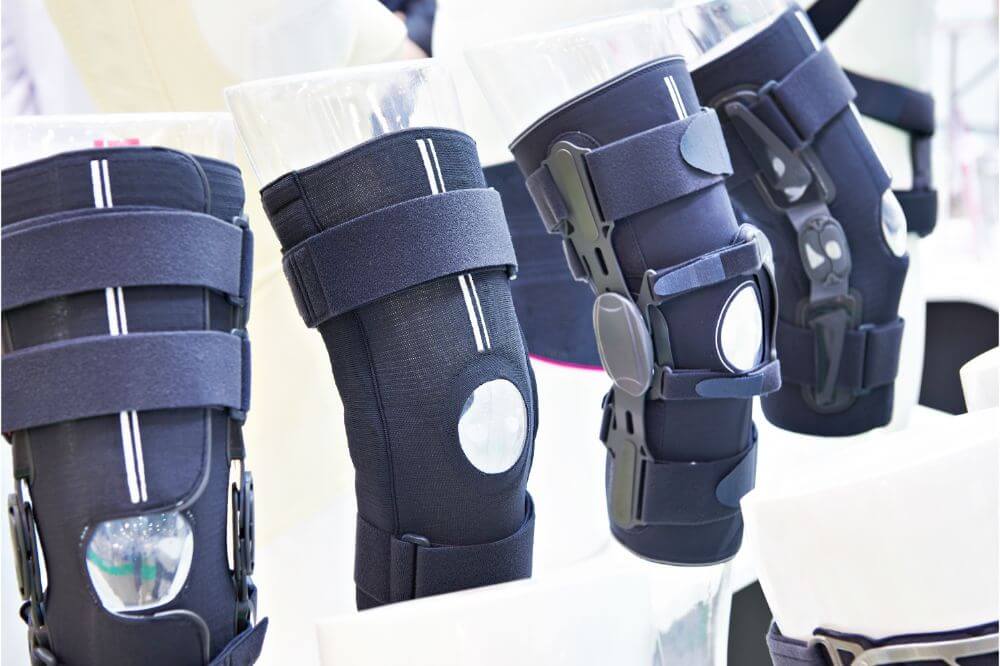
The Different Types of Braces for Joints
Whether your knee pain is from a torn ACL or caused by arthritis, there is a knee brace that is right for you. There are obviously different types of braces made to rehabilitate various different types of knee injuries. Here are the most common types of braces available:
Hinged braces are ideal for athletes who are recovering from surgery or ACL, MCL, or PCL injuries. They work great for providing both protection and stabilization; both of which are required to expedite the healing process. Hinged braces are also an excellent option for preventing hyperextension of the knee.
It’s also important to note that there are two different types of hinged knee braces available — either rigid or soft hinged. Rigid braces are ideal for athletes who play contact sports as they provide the maximum amount of support. On the other hand, soft hinged braces are a good choice for minor injuries that may only require mild to moderate support.
Compression wraps are a good choice for bracing knees suffering from mild to moderate chronic pain, such as arthritis patients. They are made to redistribute the weight bearing load while also providing enough support to still allow you to perform while playing sports or undergoing physical training.
Compression wraps tend to work great for decreasing the amount of pain you experience from general day-to-day movement. Another benefit that they provide is the ability to comfortably fit under your clothing as well.
Wraparound braces are another common option for individuals who suffer from mild to moderate amounts of joint pain. They’re incredibly easy to put on and take off. Not only that, but they’re also available in a few different options, including as a simple band or strap.
They work remarkably well because they are designed to apply a comfortable (yet effective) amount of pressure on the knee.
As with compression wraps, wearing wraparound braces fit easily under clothing and tend to be quite comfortable to wear when compared with hinged braces.
Last but not least there is also always the option of having your own custom braces made. You’ll need to see a specialist who will take measurements of your knee in order to create exactly the type of brace best suited to speed up your recovery.
Conclusions
There are two other important things to keep in mind when it comes to differentiating between the different types of braces available for joints — and that is whether you want a knee brace with an open popliteal or one with an open patella.
The popliteal is found on the back of the knee, and braces designed with an open popliteal are designed with ventilation in mind to help keep your body cool when moving.
On the other hand, a brace with a closed popliteal can help to keep your body warmer during the colder months of the year.
A knee brace with an open patella can help to relieve knee pressure while also providing an adequate amount of support with knee cap tracking. Alternatively, a closed patella helps to provide even more compression and support.